78 rpm Miscellaneous Record Labels
Just a collection of interesting labels that really don't fit in with the rest ...
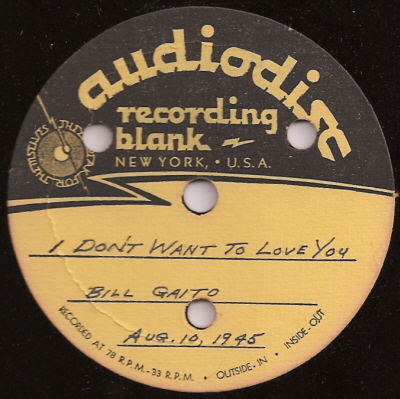
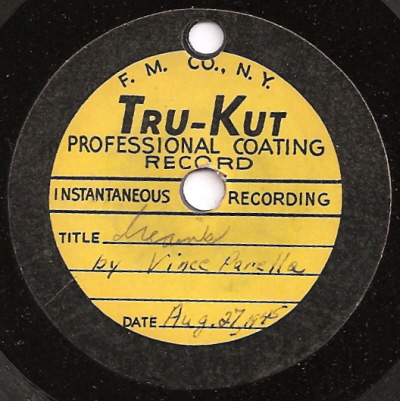
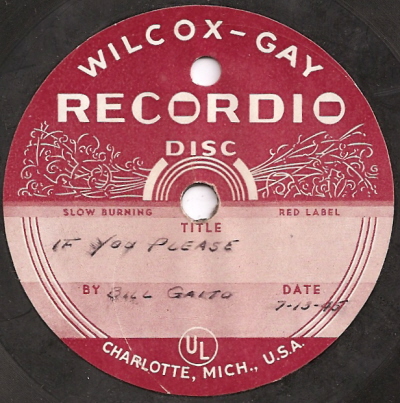
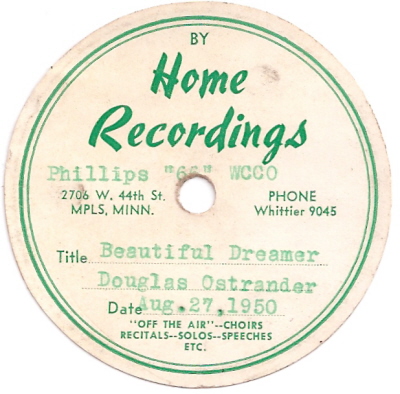
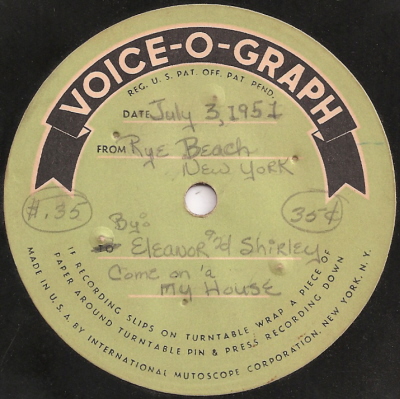
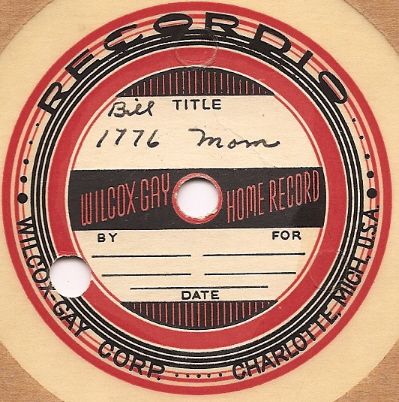
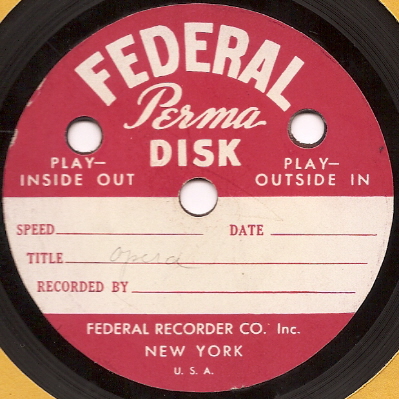
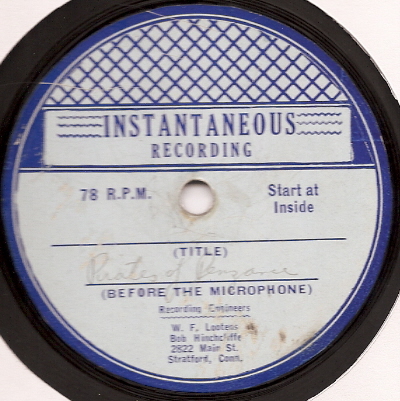
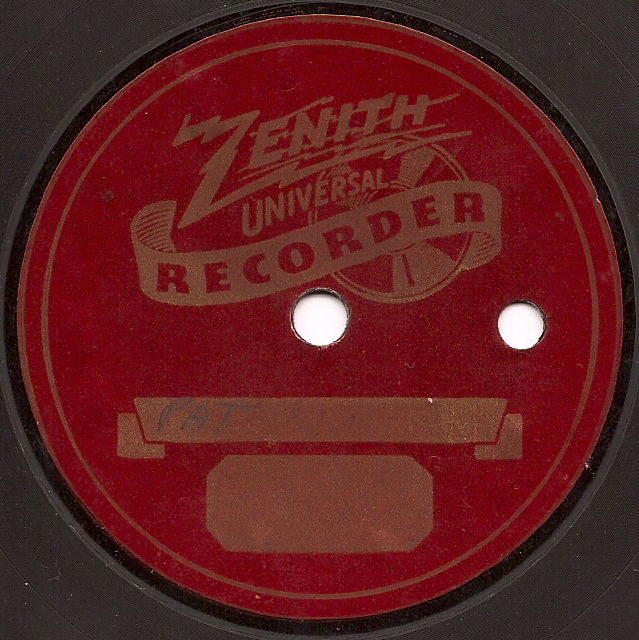
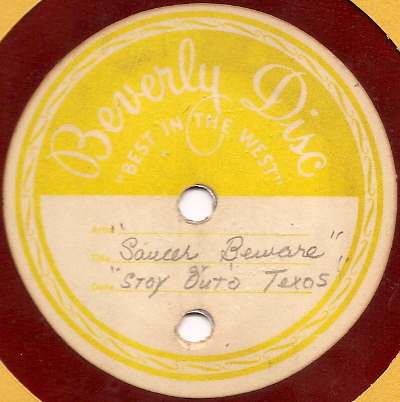
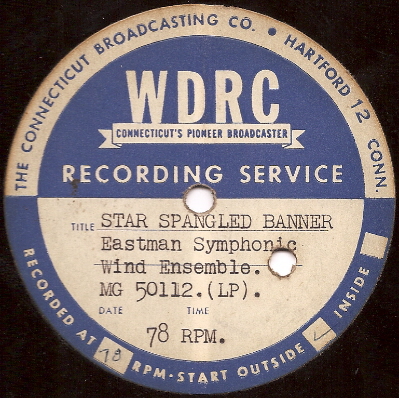
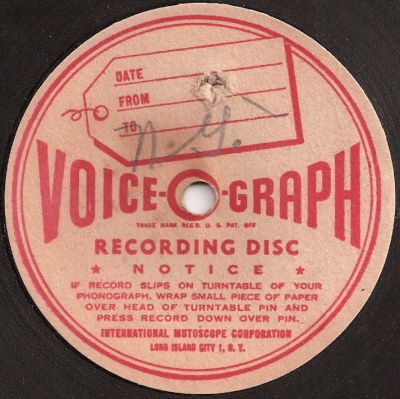
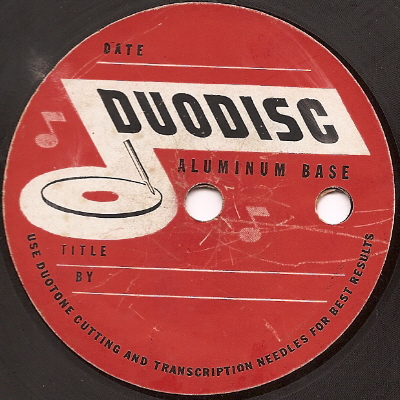
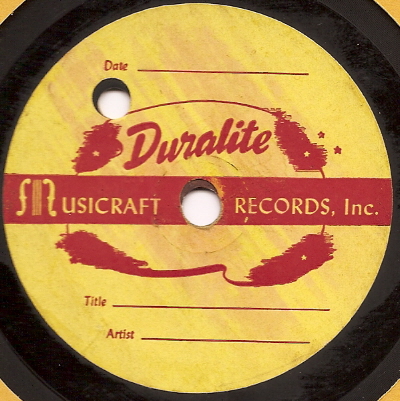
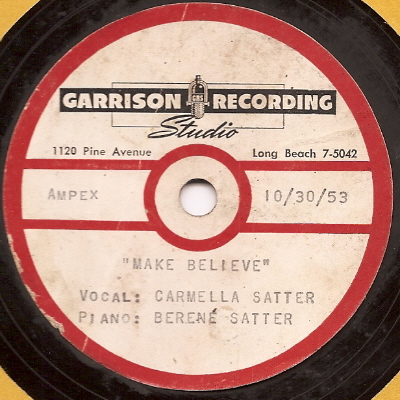
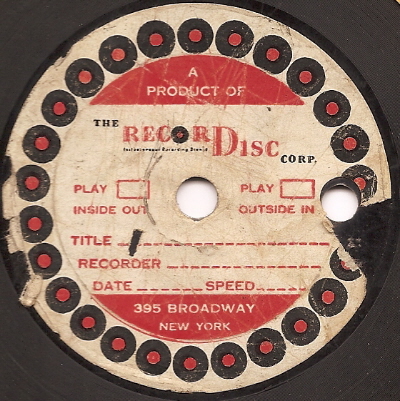
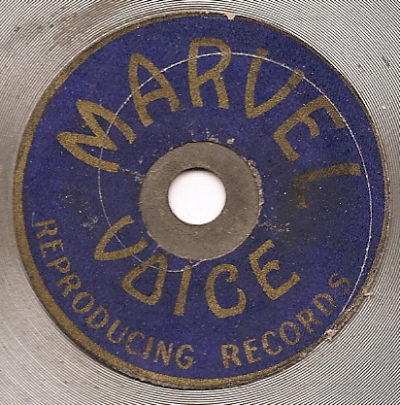
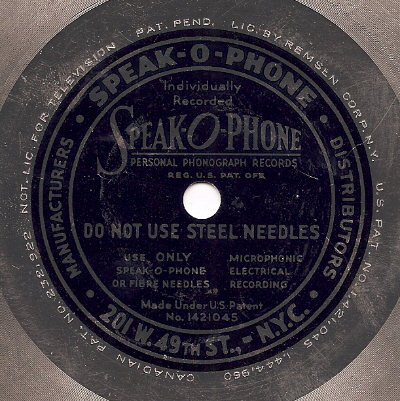
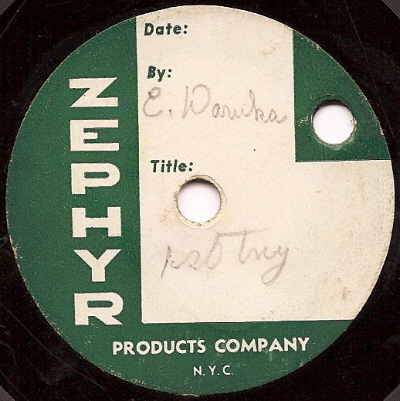
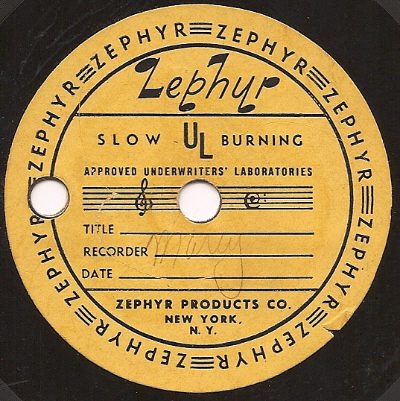
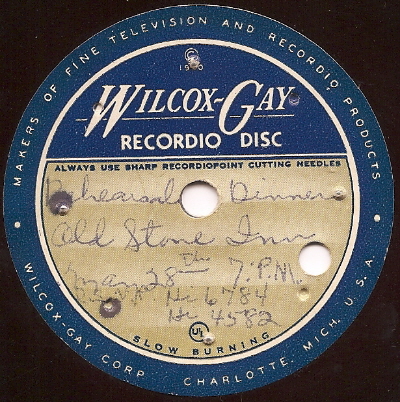
The following twenty four records (audiodisc, Tru-Kut, Wilcox-Gay, Home Recordings (found in a record album with no record attached to it!), Silvertone, Motorola, Philco, Voice-O-Graph, Beverly Disc, Federal, Instantaneous Recording, Zenith, Duodisc, Duralite from Musicraft, Garrison Recording Studios, RecorDisc, Speak-O-Phone, Marvel Voice, WDRC, Zephyr) were all personal recordings. These could be done at home if you had the equipment or in a studio. I've seen recordings of soldiers sending home a record to their family during WWII. The first three (audiodisc, Tru-Kut and Wilcox-Gay) all have dates of 1945. The Beverly Disc proudly proclaims "Best in the West." The Instantaneous Recording was done in Stratford, CT where the disc was found in August 2009.
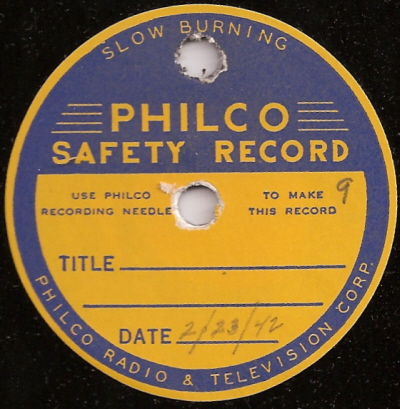
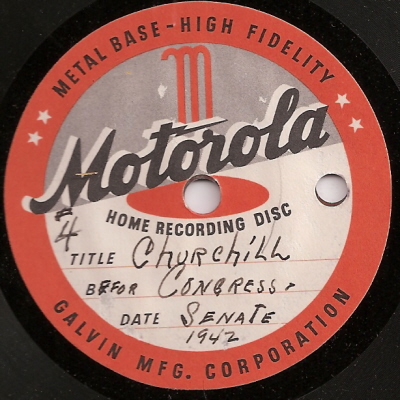
The two records to the left came from a collection of 20 discs containing both Franklin Roosevelt and Winston Churchill speeches in 1942. The Motorola disc is an address to the House and Senate dated 1942 (I have yet to do further research to determine exact date). The Philco disc was a recording of one of Roosevelt's Fireside Chats, on Feb. 23, 1942.
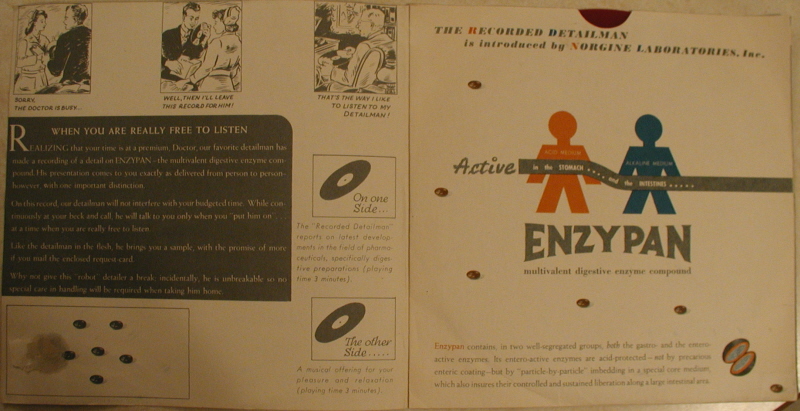
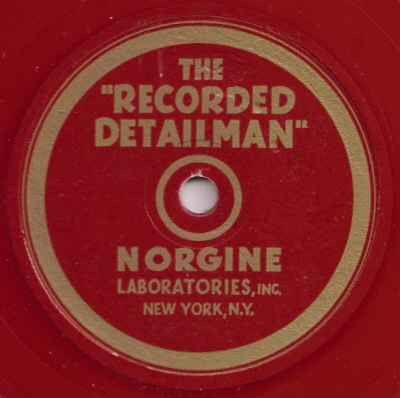
For those of you in medical sales the following will be of interest. Below is a record that a salesperson would leave behind with a doctor if the doctor was unable to meet with the salesperson. On one side is the product details and the other is a classical music selection. Below the record is the front, inside and back of the jacket that holds the record.
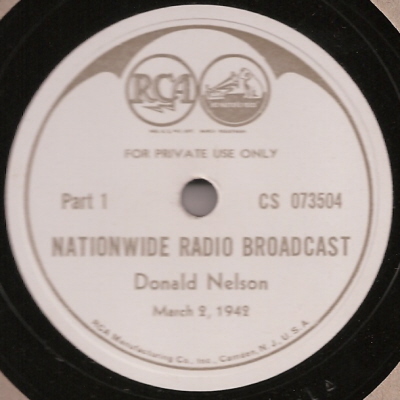
The following record (left) is from a two 12" record set of a radio announcement by Donald Nelson, president of the War Production Board. It is a call to companies and individuals to step up the pace of war production materials. The following excerpt is from Wikipedia about the WPD. This really belongs on the Victor page but because I wanted the space to write about it I've put it here.
During World War II, the government needed to ensure that the armed forces and war industries received the resources for thier ever-growing need. The War Production Board (WPB) assumed that responsibility. The WPB decided which companies would convert from peacetime to wartime production and allocated raw materials to key industries. The WPB also organized nationwide drives to collect scrap iron, tin cans, paper, rags, and cooking fat for recycling into war goods. Across America, children scoured attics, cellars, garages, vacant lots, and back alleys looking for useful junk. During one five-month-long paper drive in Chicago, school children collected 36 million pounds of old paper, or about 65 pounds per child.
The heads of the War Production Board, Donald M. Nelson from 1942-1944 and Julias A. Krug from 1944 to 1945, had great and wide reaching control over the economic affairs of the United States. Over its three-year lifespan, the board supervised the manufacture of $185 billion worth of weapons and military supplies. It offered businesses lucrative contracts to switch over to war production, and large commercial farmers also had incentives for war production. Labor unions offered "no strike pledges" during the war, although few were kept, and taxes in general were raised, all in an effort to get the country prepared for war. New York investment banker Ferdinand Eberstadt was appointed chairman of the Army and Navy Munitions Board and vice chairman of the War Production Board. Eberstadt developed the organizational structure known as the "Controlled Materials Plan" that allowed the armed forces to prioritize their needs that in turn allowed the private sector to prioritize its production to meet the military's needs.
The War Production Board was quickly dissolved in November 1945, after the defeat of Japan. The Civilian Production Administration was set up in order to take over the reconstruction aspect that the WPB would have overseen.
Labels compiled from the collection of Glenn Longwell. Page last updated on November 15, 2010
Please email if you have questions, corrections or comments on anything you see. Thanks.
info@majesticrecord.com
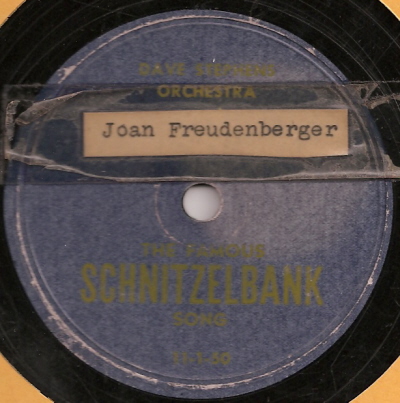
This record reads Dave Stephens Orchestra "The Famous Schnitzelbank Song" 11-1-50. I'm assuming that Joan Freudenberger was the owner of the record. It's two sided but the second side doesn't have the label and looks like it was purposely destroyed with a repeating scribed pattern into the record. I have seen one other of this record and it was the same. I chose not to pull the tape off to see if there's something under Joan Freudenberger. There's no matrix number on this side, only "Reco-Art" scratched in.
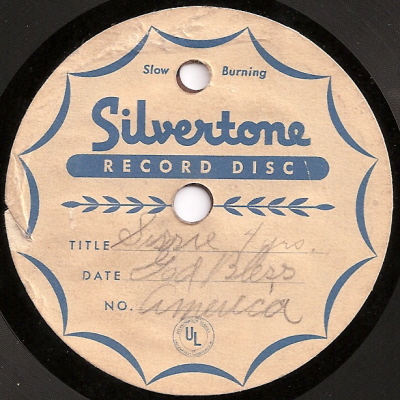
Silvertone was sold by Sears (see their commercial records under labels 'S'). They sold their own line of home disc recorders so naturally had their own blanks. This is a 6 1/2" record and the content is a 4 year old named Sussie singing God Bless America and Jingle Bells. Very entertaining ...
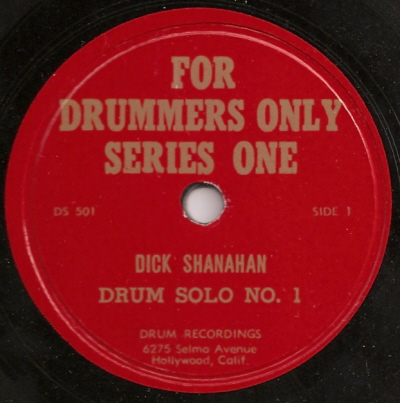
Drum Recordings, Hollywood, California. This is drum instruction.
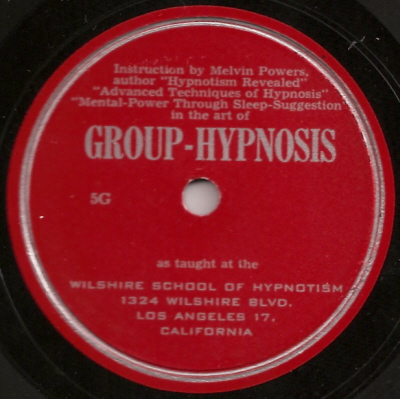
Instruction by Melvin Powers as taught at the Wilshire School of Hypnotism, Los Angeles, California. This side is Group-Hypnosis. The flip side is Self-Hypnosis. Likely from mid 1950's as the last book by Powers listed on the label came out in 1952.
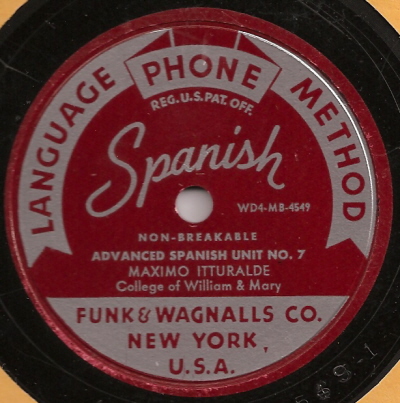
Funk & Wagnalls Co, New York. Pressed by Victor and based on the matrix number, 1944. Language Phone Method Spanish instruction.
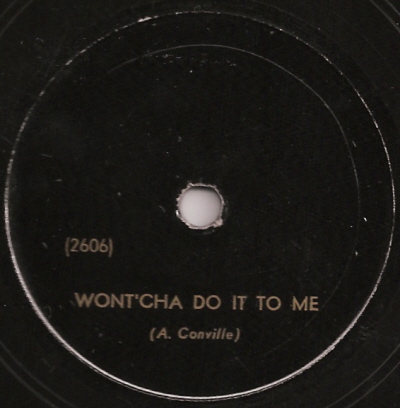
This record has blank labels on both sides and only song names and both by A. Conville. Based on the name of the song on this side "Wont'cha Do It To Me" and no label this would obvsiously be a party record of some sort. But the song is pretty lame for this category. The other side is "After Tonight" and if I didn't see the label I would never have considered it a party song (still don't). According to Steve C. Barr the label is General.
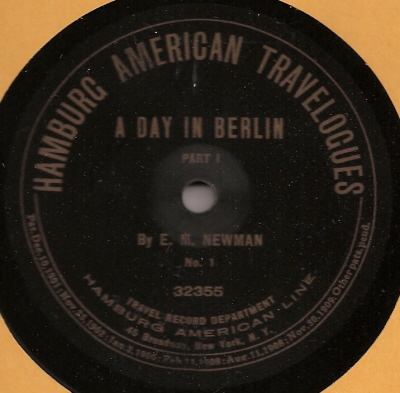
Hamburg American Travelogues, A Day in Berlin, Parts 1 and 2. This record shows it to be "No. 1" and am assuming this was the first in a series of records for travelers. Have never seen another. It was issued by the Travel Record Department of the Hamburg American Line. It's a descriptive record telling of the various sites and attractions in Berlin. This was pressed by Columbia and based on catalog number is between 1913-15, and likely before WWI broke out in 1914.
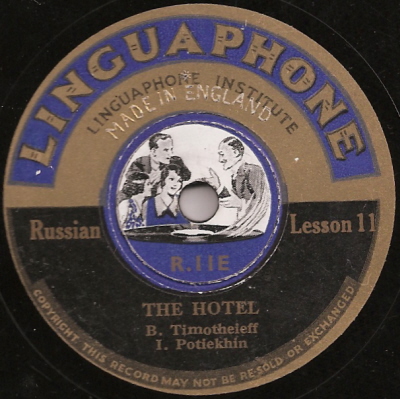
Linguaphone. This was made in England. Date unknown. This is from a fairly large set of which this is the only disk I own. This is lesson 11 and 12.
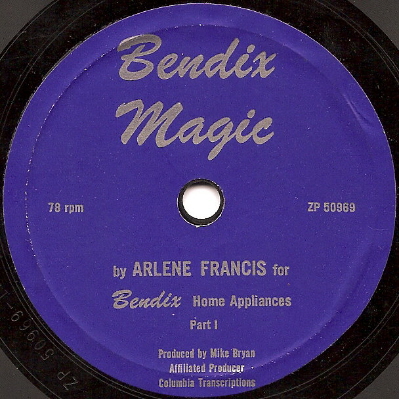
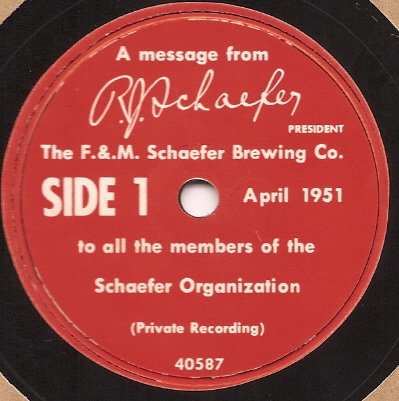
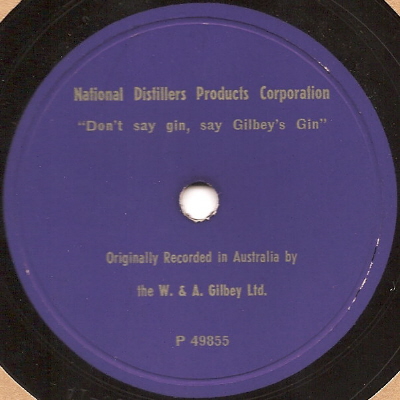
The four records below are more advertising records. The first is an 4" square flexible cardboard record that I found in behind the record storage cabinet in a Victrola that I bought. It's an Oldsmobile advertisement. When my turntable gets working again I'll be able to get the date. The next one is a 7" record done by Arlene Francis for Bendix Home Appliances. This was manufactured by Columbia. Date is unknown but is likely 1950s. The third one is a 10" record from 1951 by the F.&.M. Schaefer Brewing Company. Side 1 is a message from the President to the company and Side 2 is the new Schaefer Jingle that will be heard on Radio and TV. The fourth was put out by the National Distillers Products Corporation and is "Don't say gin, say Gilbey's Gin." The other side is "The P.M. Song." This looks to be pressed by Columbia.
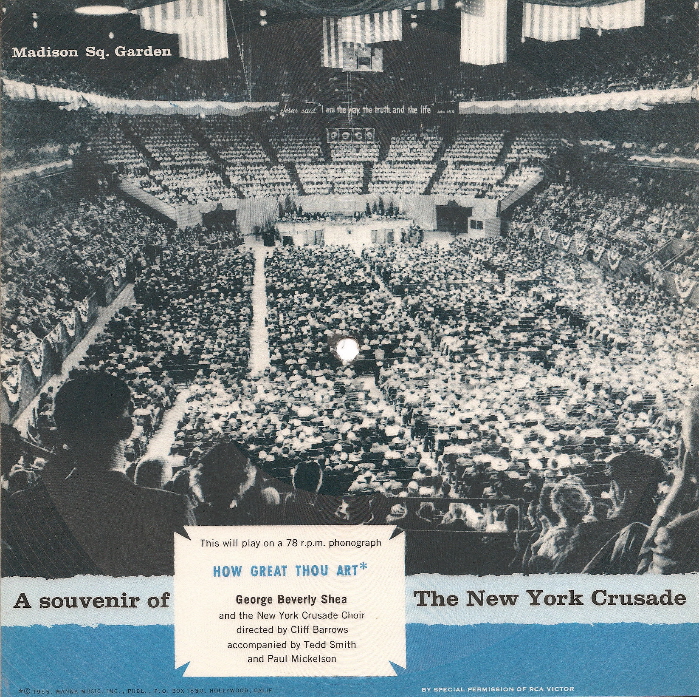
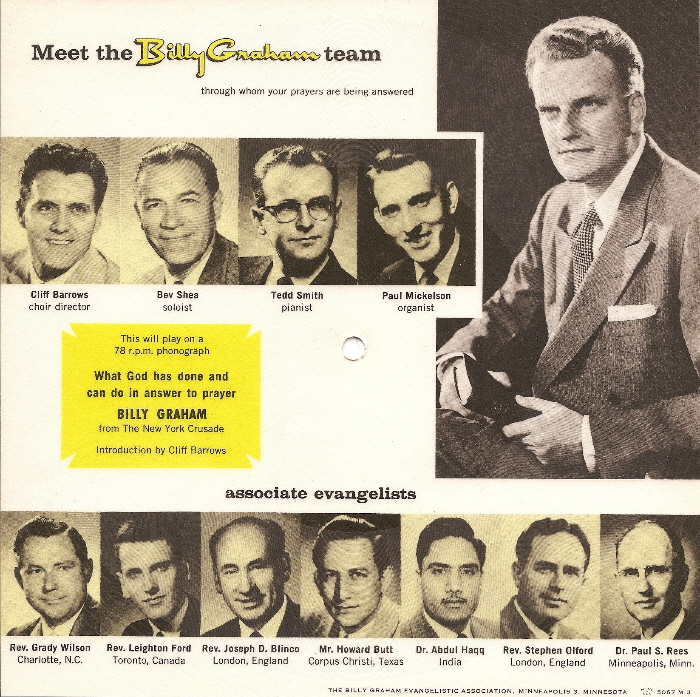
These two images are both sides of the same record. It's a square, flexible record of Billy Graham from 1955, 5067 M 3. It says "A souvenir of The New York Crusade" and is a picture of a filled Madison Square Garden. The flip side is the Billy Graham team. It also says on the lower right of the Madison Square Garden side "By Special Permission of RCA Victor."
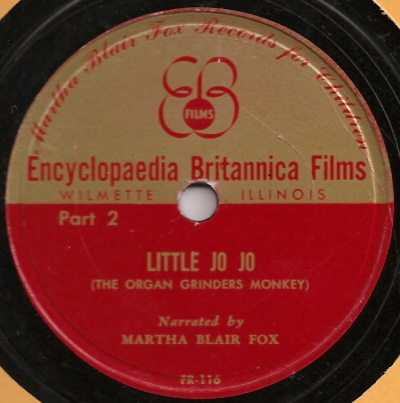
Encyclopaedia Britannica Films. Wilmette, Illinois. Date ?.
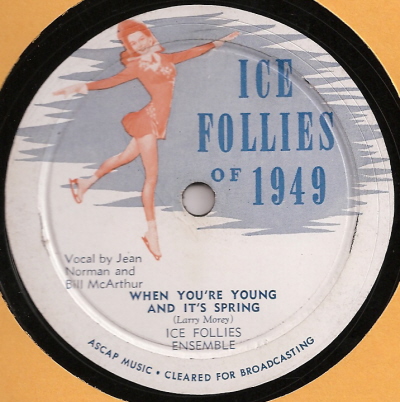
Ice Follies of 1949. Anyone know the story behind this record? Was it a promotional record?
The two personal recordings to the left, Speak-O-Phone out of New York City and Marvel Voice were both aluminum discs. The Speak-O-Phone even mentions not to use steel needles for playback as the hard steel would destroy the soft aluminum grooves. Fiber, bamboo or cactus needles were recommended.